
History shows that many dominant businesses and regimes don’t always survive. It also shares lessons; don’t allow despotic lunatics to seize power, do stay true to your founding principles, try to keep people (your customers especially) happy and don’t make too much of a mess. Oh, and make your bed every morning.
Some industries decline because their time is up – in many parts of the world, the coal mining industry has all but disappeared as demand has shifted. There isn’t much demand for whale oil these days, given superior alternatives and environmental concerns.
The usefulness of a product or technology alters other things in time, too; Jay Leno has commented that the automobile was the saviour of the horse: since they were no longer required for transport and cargo, more horses could live a better life in their fields than being beaten and dragged through stinking cities full of other horses’ effluent.
Christmas Day 1969 – pivotal for Switzerland
They didn’t know it at the time, but the valleys of Switzerland between Geneva and Zurich (the Jura Arc) were about to be shaken to their core on 25th December 1969. Cities and small towns all across the country were known for their production of clocks and particularly watches.
It wasn’t always thus – prior to the Swiss establishing dominance in watchmaking, England was the centre of that world. Even Rolex was founded in London. But when wristwatches really started taking off after the World War I, that strip of northern Switzerland set the pace. Even today, people will comment on a finely tuned machine as being “like a Swiss watch”.
The disruptor technology
Over 90,000 people were employed in the industry across Switzerland in 1970, but that fell to around 1/3 over the next 15 years thanks to a competitive threat which they had not really taken seriously enough: Quartz.
In essence, a traditional mechanical watch measures time and displays it by advancing the hands, using a tightly coiled spring to power the many components within. The spring needs to be kept under some tension – either by hand-winding every day or two, or by an automatic watch converting the wearer’s movements into tightening the spring. Then there’s the balance & escapement which perform the same role as a pendulum swinging back and forth in an old clock – they regulate the timing.
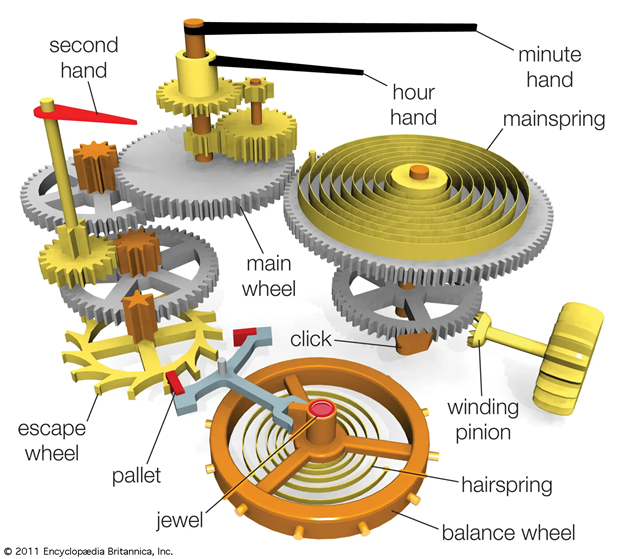
The downsides of all these mechanicals are that they’re relatively expensive to make, and the fine lubrication involved will ultimately dry out, meaning the watch will need servicing every few years. They’re potentially affected by magnetic fields and don’t like sudden shocks (like being dropped) much either.
Advances had been made in coming up with electric clocks and watches since the 1950s, with tuning forks or quartz crystals and powered motors taking the place of the traditional spring/wheels/escapement arrangement. It’s one thing having a wall clock that is powered by mains or even a big battery, but miniaturising the same technology to make a practical pocket watch or wristwatch was proving difficult.
Quartz watches used a small electrical charge to vibrate a crystal in place of the balance/escapement, and using small motors to move the hands instead of a series of wheels. A small battery replaces the whole main spring for powering the lot.
One tell-tale difference between most analogue mechanical and quartz/battery watches is that if there’s a second hand, it’ll move relatively smoothly on a mechanical watch but on a quartz watch, it’ll jump one second at a time. That’s a way of preserving battery life – rather than powering the actuator which moves the hand once every fraction of a second, it’ll be only every second, or even every few seconds when the battery starts to run out.
Here’s a slo-mo of a mechanical 1974 Omega Speedmaster and a quartz 1983 Seiko “Speedmaster”, where the chronograph timers on both watches are active. The Seiko’s main hand does move in distinct one-second jumps, but the 1/20th seconds marked out on the subdial at 3 o’clock is hilariously quick.
The seeds of demise for the traditional Swiss watch industry were laid bare when the first quartz watch available world-wide was released on Christmas Day, 1969: Seiko’s Quartz Astron.
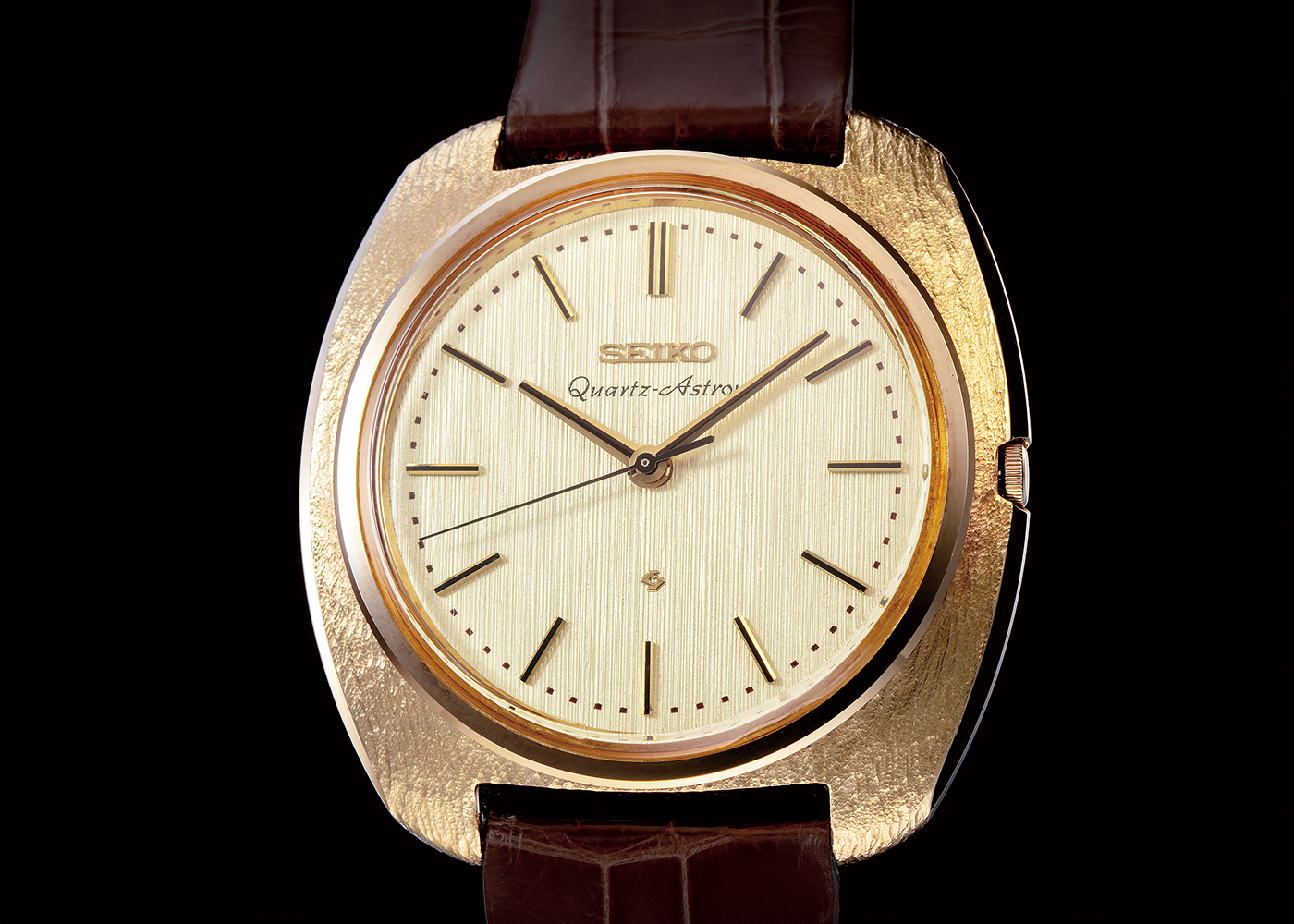
Although we later got used to quartz watches being cheap to the point of being disposable, the 35SQ Quartz Astron was not. Described as being around “the price of a small car” (¥450,000– about US $10,500 in today’s money), it was 18ct yellow gold with a distinctive hammered finish and very much pitched as a luxury good.
It’s not about being first
The Swiss has been investing in tuning forks and quartz for years, and by the late 1960s, there were viable quartz movement in Swiss labs. They followed Seiko to market in early 1970, but the watches that used the early movements were chunky and the batteries needed replacing too often. The Swiss industry was seemingly not overly concerned about quartz – although they were far more accurate than mechanical watches, they were initially more expensive and the cost and hassle of getting your old watch serviced every 5 years was still better than having to replace your quartz watch’s battery every few months (or even, weeks).
In hindsight, what followed could have been a case study in The Innovator’s Dilemma: quartz movements, and the watches they were fitted to, became radically simpler, cheaper and more efficient. Batteries lasted longer, and they quickly met the need of the majority of watch wearers worldwide. The bottom fell out of the Swiss watch industry and caused a near-death experience referred to as “The Quartz Crisis”.
Other factors played a part
It wasn’t just arrogance or blind sidedness on the part of the incumbent Swiss manufacturers which created the problem. The fuel crisis of the early 1970s – which also had seismic effects on many other areas like the automobile industry – combined with the Swiss Franc gaining over 50% in value against the US Dollar, meant that there was much less demand for their product anyway. Allied to the sudden availability of cheaper, more reliable watches from Japan, the US and elsewhere, meant the Swiss industry was in freefall.
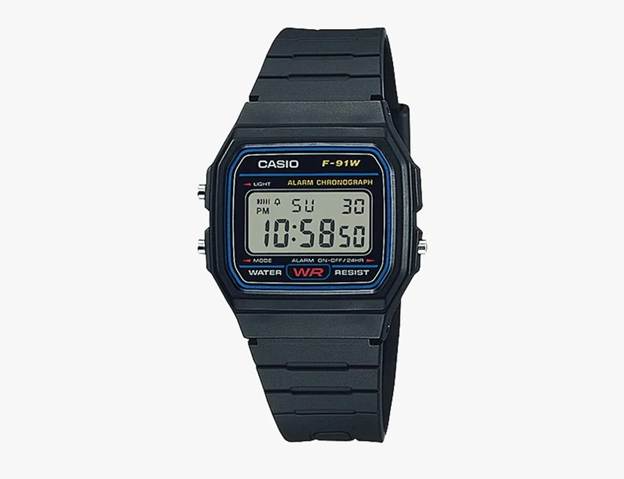
As time went on, the analogue quartz watch was somewhat displaced by the even simpler digital LCD one; Casio’s F-91W has been in production for more than 35 years, and it’s said to sell 3 million a year because it’s so cheap ($20).
The recovery
To revisit Jay Leno’s earlier comment, when no longer needed for transport, the use for horses morphed into sport or pleasure rather than utility. Maybe that meant there were fewer horses around overall, but it also meant the quality of life for the remaining ones was much better. And for everyone else, too – 1,000 tons of horse 💩 supposedly was dropped in New York City every day.
With ultra-cheap yet reliable and robust watches being available, there’s no need to pay thousands of dollars (millions, even) to have something on your wrist just for telling the time. Many people won’t have the need for any watch, since they have a phone with a clock on it … unless the watch does something more.
Tech firms like Apple, Samsung and Google have redefined the wristwatch for a lot of people by making it smart; by volume, Apple sells more smart watches than the entire Swiss watchmaking industry combined. By value, it’s a very different story.
By focussing on “luxury”, associating with famous brand ambassadors and the like, the Swiss industry has largely reinvented itself as a premium product, made not for the utility of telling the time but for looking and feeling good.
