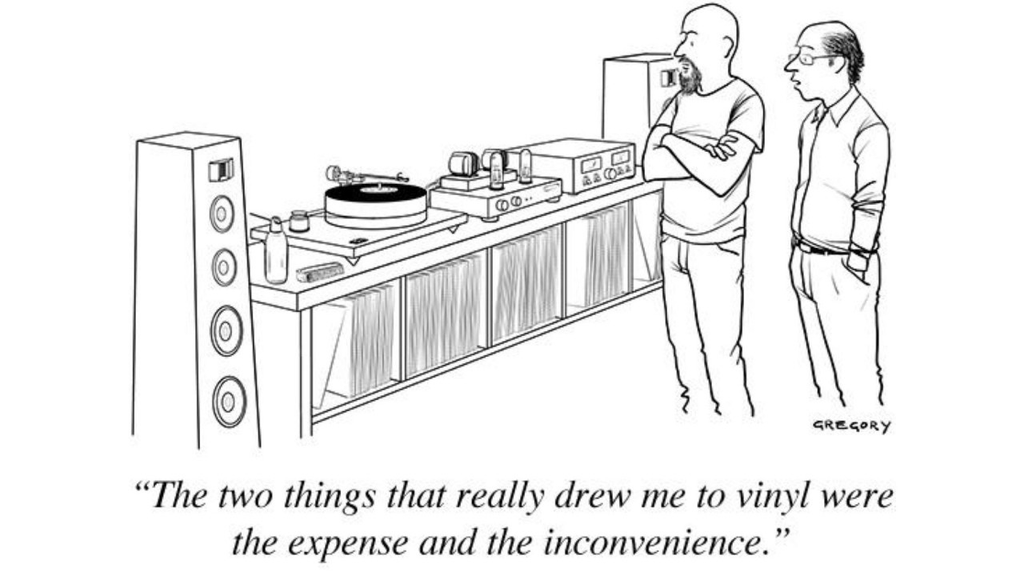
New Yorker cartoon by Alex Gregory, 25 May 2015
The media on which people consume music and video has evolved through clear phases in its history. The wax cylinder gave way to spinning vinyl, a variety of tape formats competed and were ultimately superseded by shiny plastic discs read by lasers. Ultimately, all have been deemed irrelevant by streaming and digital storage but even allowing for the “format wars” that have run for sometimes decades, this is one of a few examples where users are choosing technology which is regressing.
Main cartoon image source: New Yorker, May 25 2015
The music media wars
By the 1960s, the dominant form of music that people consumed was vinyl, particularly 7” singles. Radio of the time wasn’t very good quality – but that didn’t stop the Rock & Roll revolution powered by scratchy AM transmissions from the likes of WINS 1010 in New York or Radio Luxembourg broadcasting across Free Europe.
The kids would listen to the radio then rush to buy the latest records to play on their Dansette, in glorious mono. Some car manufacturers even fitted record players under the dash (amazingly, even until the mid-1970s…)

The 8-track cassette cartridge had a brief moment in the sun, especially in-car, and had some theoretical advantages over other formats (like support for quadrophonic sound), at least at first.
The Compact Cassette arrived in the mid-60s, allowing people to record stuff off the radio or from their own records, perhaps making compilations or “mix tapes” for themselves or to share. Cassettes were smaller and much more usable in cars – and as the composition of the tapes themselves advanced, they trumpeted improved sound quality. Technology like Dolby noise reduction improved things too.
It was the arrival of the Sony Walkman and its ilk in the early 1980s really cemented the cassette tape as the primary format, for pre-recorded music as well as DIY.

Source: Google Gemini
So, the pattern is set – a format or technology that has evolved as much as it can ultimately gets overtaken by another one, even if the quality isn’t initially as good. The same thing happens all over – see the 1st chapter of The Innovators Dilemma, which shows 5.25″ hard disks being replaced by initially less good 3.5″ ones, upending the storage industry of the time. When a new technology gets at least as good as a previous one, and becomes more convenient and/or less expensive, it seems like a one-way journey to its adoption.
Audiophiles in the 1980s would point out that cassettes never sound as HiFi as their vinyl, even before the tape gets accidentally scrunched, stretched or dusty. Quality doesn’t always matter as much as convenience, and the tape was cheaper and more easier for most people.
You can see where this is going. The Compact Disc arrived in early 1980s and despite being initially more expensive than both vinyl and cassette, quickly established dominance. Objectively, it does sound better, it doesn’t need rewinding and is supposedly dust and scratch resistant. Oh, and you can random access a CD to skip tracks without faffing around with ffwding or dropping a needle.

By the mid-1990s, vinyl had flatlined to irrelevance, CDs were still booming and tapes were starting to lose their place, at least as a medium for recorded music. Arguably, this was the best time for mix-tape creators as it was easy to record tapes from borrowed CD sources that would sound as good as pre-recorded cassettes might, so sales of blank cassettes were still peaking.
Fast forward another 20 years though, and the format had changed again – and we’re not even looking at streaming services. When MP3 appeared in the mid 1990s, it was at the forefront of digital music. Storage devices were still low-capacity and expensive, especially portable ones – at the time a 1GB hard drive would cost well over $1,000. Even by 2000, the relatively new SD card was $200 for 64MB … enough to store maybe a couple of dozen MP3s?

The dramatic fall in costs and rise in capacity of mobile storage, combined with easy sharing (via Napster or just giving copies to friends) allowed digital downloads to massively overtake and displace CDs. Portable MP3 players like the iPod killed the cassette almost entirely.
Digital formats
There was a time when the format that digital music was stored in echoed previous commercial battles within the same basic device type – VHS vs Betamax for video cassettes (or even V2000 if you can remember that), Laserdisc vs DVD, Blu-ray vs HD DVD etc.
MP3 was effective at reducing the size of stored music, but it is “lossy” – arguably, it throws away the data that you don’t really need, in favour of being more convenient (i.e. You can fit 20 or 30 MP3s on a media card, rather than 1 or 2 uncompressed files).
Microsoft tried for a while to cement its own standard, Windows Media Audio (WMA), as an alternative. Using a better mechanism to do the compression (and have the option to be lossy or lossless depending on your preference), WMA could create smaller files that sounded better than MP3, at least if the bitrate of the conversion was low. Microsoft saw WMA as a licensing opportunity, to the point where lots of hardware devices that played MP3 could also play WMA files – CD players reading files off a CD-ROM for example, useful in-car when you could fit 100+ files on a CD instead of only 70-odd mins of music on an audio disc.

There was also a misguided attempt to shoehorn Digital Rights Management into WMA, meaning that if you used Windows Media Player to “rip” a CD on your PC, it would create WMA files that had rights protection applied. The intent was to try to prevent illicit copying, and Microsoft had a certification and licensing program for 3rd party devices called PlaysForSure, meaning you could legitimately copy protected content (such as tracks bought from its MSN Music store) to supported 3rd party devices.

Before Apple’s iPod came along and swept everything before it, there were a variety of portable media players – Creative Labs pioneered the HDD-based Nomad in 2000 and the range evolved in competition to iPod for a few years. One example is this Creative Zen Micro music player c2005, which had a 4GB hard disk spinning away inside.

Somewhat ironically, when Microsoft launched its own late-to-market music player, the ill-fated Zune in 2006, it was not compatible with its own PlaysForSure standard. So, if you’d already bought and downloaded protected content from MSN Music, you couldn’t load it onto your new Zune without buying it again from the Zune Marketplace.
The lesson? Don’t trust “owning” anything that is dependent on a company allowing you to continue to play it… MSN Music and Zune are now all gone and if you come across media that was protected by them in the past, you’re unlikely to be able to play it since the services that validated the license are not there anymore. Microsoft did publish a tool that might help you un-DRM your own media though… good luck with that.
Amazingly, MP3 players are staging a comeback, of sorts. If you have £130 doing nothing, you can also buy a rechargeable Bluetooth capable cassette player.

The Renaissance
In an unlikely twist, vinyl record sales started to take off again in the mid-2010s. Digital streaming is, by a long way, the biggest player – in the US it now accounts for 82% of revenue vs 12% for the total of physical media.

Nowadays, vinyl accounts for an ever-increasing slice of the pie. Although unit volume in the US overtook CDs in 2022, in the UK, CDs still outsell vinyl (just): in the first half of 2026, 4.2M CDs were sold, compared to 3.8M vinyl LPs. But the value is telling – with the average price of an LP being more than double that of a CD, that’s where the money is. In fact, in the US, vinyl accounts for 75% of physical media revenue, so 9% of total music revenue.
The trend in the UK is lagging a little – vinyl sales by volume is still growing by 15%+ YoY and CDs are shrinking by ~5%. Even though some artists are releasing new music on vinyl, CD and even cassette, most new stuff goes straight to streaming platforms.
And most listening does too…