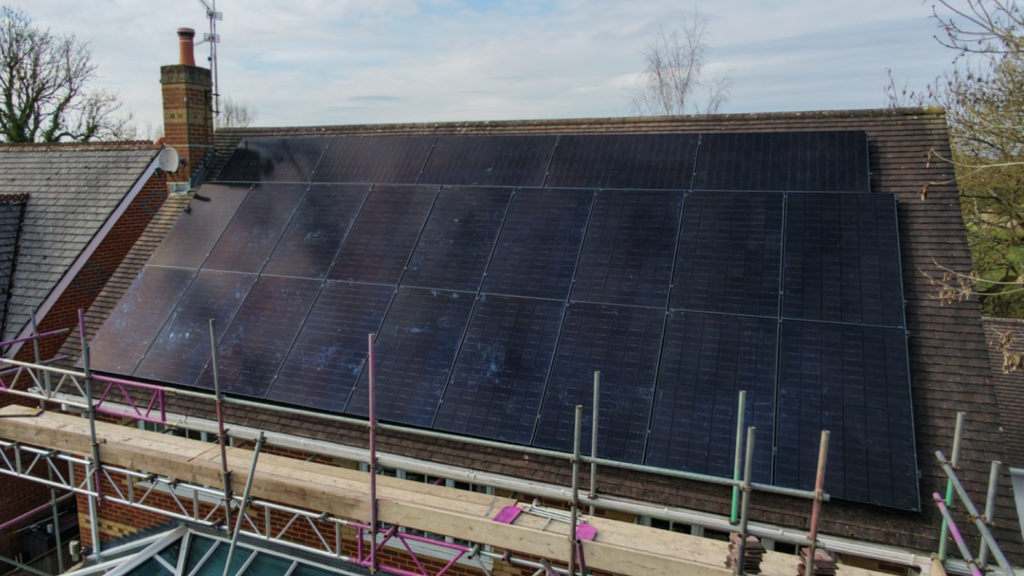
A personal tale this month, since we decided to switch our home to a more self-sufficient and less carbon-intensive form of power. This is a topic that many people seem to be interested in, so I thought I’d share some experiences and, early days though it is, some numbers.
If you think climate change isn’t real and that burning coal is just fine because we’ve done it for longer than many countries have existed, then perhaps this journey is not for you. Given the seemingly endlessly rising energy costs fuelled by the clowns and fiends in global government, now felt like a good time for me to make this move.
Saving money in the short term wasn’t on the cards, given that it costs quite a bit to make this happen as a retro-fit on an existing house. It might make the house a bit more desirable if and when we come to sell it, but that again is not the reason to do it. Also, like any tech decision making, the end goal sometimes gets a bit lost in the process and you find yourself doing things just because it would be “better” (or just “because”).
The catalyst for us was the decision that we’re not going to be moving home for the foreseeable future. We decided, therefore, to fit the solar panels.
The business case for solar + battery
As soon as you start looking into this area, you’ll likely see lots of online ads punting the idea that solar panels can pay for themselves in no time, or even that there are schemes where they won’t cost you anything to install. As with all such things, your mileage may vary and there are plenty of operators who are maybe best avoided.
The first thing to think about is how much energy you are currently using, as measured in kilowatt-hours. As any skoolboy kno, this means if you had a device (like a kettle or a heater) which says it uses 2,000 watts, then in a whole hour of it working at full tilt, it would consume 2kWh. At least for UK users, you’ll see how much power you use by looking at the meter readings on your electricity bill.
If you could reduce your power usage by (say) £100 a month, it’s still going to take you some years for the project to pay for itself, but there is a certain degree of pleasure in being more self sufficient and it gives techie data nerds something to analyse.
The idea with photovoltaic (PV) solar panels is pretty simple – you generate power when the sun shines and either use it right away or store it for later in a big battery. In many respects, it doesn’t make sense to go for large solar installations unless you also have the battery since you’re probably not going to be using many kilowatt hours of electricity during the middle of a sunny summer day. If you don’t have a means to use, store or export the energy to the grid, then the panels do nothing – i.e. if your battery is full, your house is ticking over using only 100w and you don’t have a tariff that allows you to send surplus energy to the grid, it won’t matter if you have dozens of panels because they’ll only produce what can be consumed.
Our house isn’t 100% ideal for solar panels, as the rear roof faces south-east and there are some large trees that shade part of it until the sun is high in the sky. Still, modern PV panels can be tuned to deal with partial shade. At least we have a decent expanse of roof space, and that led to the first of many decision points – how many panels to fit? Advice was given by experts on the MoneySavingExpert forum, including one who actively gets involved in sense checking quotes and even negotiating with suppliers to get better deals.
The panels themselves are rated at 550w each, and the installer talked us into adding more than we initially intended (2 rows of 9), just to fill the roof space. The idea being that a significant part of the cost of the project is the installation itself, and while you’re up there putting up 18 panels you might as well stick another row of 5 along the top. So that means we have 23 x 550w = 12.65kw in theoretical output. Of course, it never gets that high but there are plenty times when I’ve seen them produce over 10kw.

We were recommended to get a Tesla Powerwall 3 battery, partly because it contains everything in a pretty neat package, offers some additional capabilities like being able to power the house if there is a supply outage, and it gives a good usable capacity – it will store up to 13.5kWh of power. There are cheaper alternatives and some which give more access to be able to tweak and control what’s happening, but we thought we’d want the one that seems to offer the best mix of features, even if the company CEO is a lunatic.
As well as the mobile apps, if you have a Windows PC and use a Tesla Powerwall, you can monitor it with the free Powerwall Companion …

If you’ve a Home Assistant installation, you can get some basic info from the Powerwall on the local network, though Tesla shut down some of the functionality that was there in the Powerwall 2.

We were previously with an energy supplier who gave a very good rate compared to the mainstream ones, but they didn’t offer any form of export, so we decided to switch to Octopus Energy. With the Iranian conflict causing a tumultuous time in global energy markets just when the installation was going on, it took a while for Octopus to be able to get us on a good import/export tariff, which means we can sell excess energy at any time.
The tariff lets us import energy for a few hours overnight at nearly half price, but there is an evening peak for 3 hours where it costs nearly 1.5x the regular price. Similarly, exporting during peak hours pays a lot more than during the rest of the day. Even without solar panels generating anything, it would be possible to charge the battery up fully in the off peak time and export all of it during the peak hours; great though that sounds, it would only make about £1.50 each day, so it would still take about 15 years to cover the cost of the battery.
We also gave Octopus permission to manage the state of the battery – so they can decide to charge the battery automatically in the off peak period and keep its charge high during the day, so it can be discharged during the evening peak. They call this “Virtual Power Plant” and by using several thousand houses together, essentially give the equivalent of another power station. In principle, I could build Home Assistant automations to tweak how much charge to keep etc, but this way is just easier.
The costs
Total outlay for the installation of the solar panels and the Powerwall came to just under £14,000, which is quite a lot more than I’d initially thought; early investigations were on the assumption of having fewer panels and a smaller, cheaper battery. I got into the “sod it, do it properly” mode when planning started and we ended up with a bigger and better system.
When the Tesla system was installed, our existing EV charger (feeding a PHEV car with only about 11kWh battery) was kept “outside” the Tesla gateway – the idea being that you don’t want to plug the car in and it drain the stored energy in the Powerwall. In hindsight, I should have got them to do it the other way since the charger can be solar aware, and it would be possible to set up rules like only charge the car using excess solar power unless it’s the middle of the night and electricity is cheap. I might come back to this next year.
Since switching to Octopus in March, we’ve used about 3,200kWh of electricity from the grid, costing about £800 including the standing charge, though have exported nearly 3,800kWh back, earning us £585. So the net cost of electricity for 8 months is £215.
In comparison, for the same period in 2025, we used 4,700kWh electricity and paid £1,060. We also used LPG for heating, hot water and cooking – consuming around 6,000kWh of equivalent energy and costing about £500. So this summer, we’ve saved about £1,300 in electricity and LPG charges, even though we got a new PHEV car with a bigger battery than previously, and made another significant change – switched from LPG to installing an Air-Source Heat Pump.
Pump up the Jam
While solar panels are pretty self-explanatory and most people seem to think they’re a good idea (at least on houses’ roofs), heat pumps appear to be more of a divisive topic. Red-faced media outlets are happy to proclaim what a terrible thing they are and how government subsidies to encourage their use are a waste of money. In truth, most people who don’t have a ASHP probably don’t really understand what they do.
In the UK at least, most houses have central heating that’s fired by a boiler heating up and circulating water through radiators or underfloor pipes. At its simplest level, what might happen is that when the controlling thermostat decides the house needs heating, the boiler fires up and heats the water to a high degree – older boilers maybe running at 75C – and then pumps it around to the radiators etc. When that brings the house up to the desired temperature, the boiler will stop. House cools a bit, boiler fires up and the process resumes.
Heat pumps are more granular. The process of warming the water up is like a fridge in reverse, and therefore the amount of electric power that is used will vary depending on the ambient outside temperature and the desired flow temperature of the water. The flow temperature for a heat pump will typically be a lot lower than a gas boiler, and therefore it is commonly held that in order to be effective, you’ll need bigger radiators.
The main difference in practice is that a heat pump doesn’t operate in that on/off mode that a boiler does. Rather than blasting temperature up then shutting down, it wants to be more gradual and run for longer. It can also be more effective at maintaining steady temperature by varying the how much it heats the water. Add in intelligent controls which have both an outside thermometer and even look at the weather forecast, and it can be much smarter than whatever it is replacing (it must be said, there are smart, modern boilers too).
Heat pumps use quite a lot of electricity, so can be expensive to run – but they operate on the principle that they will generate more heat than the electricity user… in other words, by consuming 1kW of electricity, the compressor and pump could generate 3kW or 4kW of heat. This Coefficient of Performance will vary depending on how well insulated the house is, how hot the flow rate is and a variety of other measures.
A case study
Our 30-year old house has never had a natural gas supply. Out front, it had a large pressurised tank storing up to 1,400 litres of LPG (mostly propane), and the gas boiler and cooker had been converted to run on LPG instead of natural gas. In practice, it was “fine”, except that servicing is a bit more complex as engineers need to maintain separate certifications to work on LPG equipment. Also, there was little choice in who to get the LPG from since the supplier owns the tank, and various rules meant it was very difficult to switch from one to another.
Given that we don’t have much choice in the supply, along with the concern that our boiler was surely on its last legs (having had several last rites performed in the past), we decided to switch to the heat pump in early 2026.
LPG is quite energy dense – one litre is equivalent to around 7kWh of power, and pricing wise it works out at about 56p/L with a standing charge of 29p/day. In practice, one litre of LPG would generate about 4kWh of heat energy and during the winter months, we’d be using 7 or 8L of LPG a day. So including standing charges, that would work out about 18p per kWh of heat. A heat pump should be able to generate 1kWh of heat for about 8 or 9p.

It’s a big old unit. This one is a Vaillant aroTHERM plus 10kw affair. It’s tucked around the side of the house and is largely silent when in use. During the hot summer, it was quite nice standing in front of it when it was running (heating water) as the output from the fans is cold air… It’s possible to reverse the direction of heat, so the pump blows out hot air and circulates cold water inside, but we didn’t get that enabled during the height of summer. Maybe I’ll play with it next year.
Anyway, our house has “wet” underfloor heating downstairs, which is ideal for heat pumps to work with. The upstairs radiators did not need to be changed, though the ASHP is probably running at a higher flow temperature than would be most efficient. If you were building a new house, you’d just factor in needing larger radiators from the start.
So far, it’s working well but we’ll find out in the depths of winter how it would compare cost-wise. Graphing our power usage (by kWh) over the last few years, we’ll likely see the 2026 blue bars dramatically overtake previous years since we’ll have the double effect of less solar being generated (so we need to import more from the grid) and the need to use more power to keep the house warm. I’ll do a side/side costing of the switch from LPG in Spring 2027. The electricity in the chart is only power consumed from the grid, not taking into account anything exported – that will feature in the cost comparisons to follow later.

There were some other benefits and additional costs in getting rid of LPG. At the same time, we had to move from a vented, gravity fed water system to a pressurised closed one. That means we have strong water pressure at every tap, though also had to replace shower pumps. The hot water cylinder moved from an airing cupboard into the loft, meaning we have more storage space too, and we don’t need loft space for big water tanks any more. The old LPG cooker went on eBay and got replaced with (an expensive!) shiny new electric one.

And I was glad to see the old LPG tank be craned away. Still not sure what to do with the space it’s freed up… maybe space to store another car…?
Costs
We used a company called Heat Geek, who are an umbrella for the supply and installation of the heat pumps. They have some bespoke software that’s used to scan the thermal efficiency of the house, and supposedly come up with a guaranteed level of performance based on their modelling.
The total cost for everything to do with heat pump install, worked out at a little over £10,000 (including the government Boiler Upgrade Scheme grant of £7,500; as it happens, a few weeks after our system went in, we could have got another £1,500 grant since we were moving off LPG… oh well). If we’d had to replace the old LPG boiler, it would probably have been in the £3-4,000 region.
If you’re in the UK and thinking of making this switch, you’d be better off doing it before the next General Election. If there’s a change of government, the BUS is likely to be sacrificed as being too woke and net zero.
The new cooker was £1,000s and there were some associated costs in getting rid of the LPG tank, so we’re probably in for £15k spend in total. All in, I’m happy. The systems are working well and are much more tech enabled than anything we’ve had before, allowing me to fritter away time tweaking Home Assistant…

I’ll report back in the spring to share how the winter went, in case anyone is interested 😊
